





Published 11 Dec 2025 –
Malaysia is moving from ambition to implementation on climate and sustainability reporting. A series of global and local policy shifts – from the EU’s Carbon Border Adjustment Mechanism (CBAM), CSRD, and CSDDD to the National Sustainability Reporting Framework (NSRF) aligned with the ISSB Standards, imminent carbon tax, and the Simplified ESG Disclosure Guide (SEDG) – is reshaping what good looks like for corporate sustainability.
At the recent Eco-Business Cities Possibilities event in Kuala Lumpur, ESGpedia joined policymakers, city planners, and industry leaders to unpack what this means in practice, particularly for Scope 3 emissions and supply chain transparency in Malaysia. Across the opening plenary on smart and mobile cities and the Day 2 workshop “Navigating NSRF: Harnessing Technology to Unlock Scope 3 Transparency”, one message was clear: Scope 3 is no longer a nice-to-have disclosure. It is central to competitiveness, access to capital, and long-term resilience.
Below, we summarise key insights from the event and explore how Malaysian businesses can start preparing for Scope 3 reporting under NSRF and supply chain transparency – in a way that is both practical and value-creating.
Why Scope 3 emissions disclosures now sit at the heart of Malaysia’s climate ambition
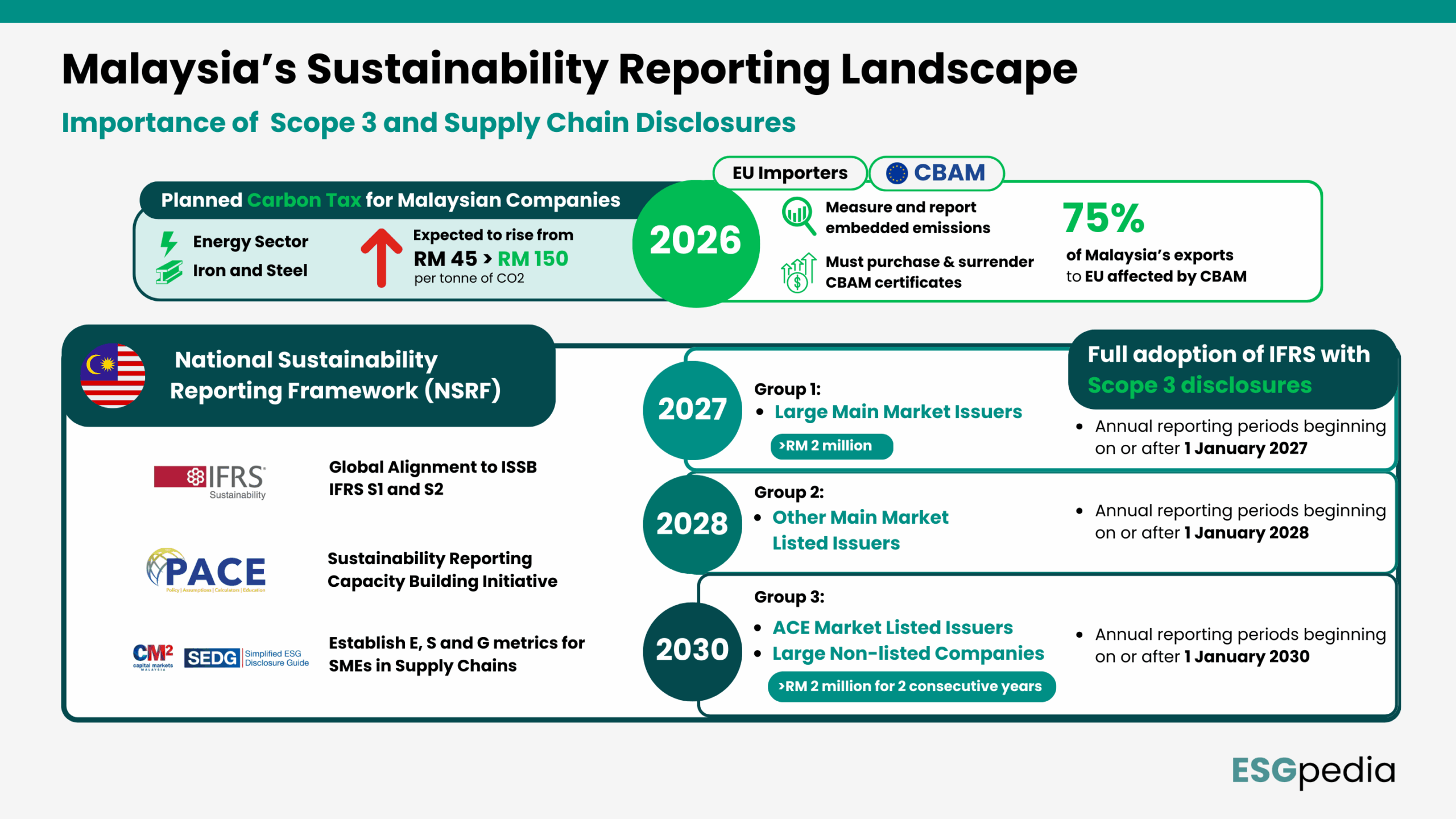
At the same time, the international regulatory environment is tightening, with the various policies and sustainability reporting standards:
- CBAM will affect around three-quarters of Malaysia’s exports to the EU, particularly iron and steel, cement, aluminium and fertilisers, and will require reporting of embedded emissions in exported goods.
- EUDR, CSRD, and CSDDD will push deeper transparency on deforestation, human rights and value-chain risks for companies selling into or operating in the EU.
Domestically, the policy signal is equally strong:
- NSRF will introduce ISSB-aligned sustainability reporting standards (based on IFRS S1 and S2) for Malaysian businesses, with a phased implementation of full adoption of IFRS standards with Scope 3 GHG emissions disclosures across three groups: large main-market issuers (Group 1 starting 2027), all other listed companies (Group 2 starting 2028) and sizeable ACE-market and unlisted companies (Group 3 starting 2030).
- The PACE initiative was launched in September 2024 to help Malaysian companies meet NSFR reporting standards in 2025.
- Carbon tax is planned from 2026, initially covering iron, steel and the energy sector, with scope expected to expand over time.
- SEDG was launched by Capital Markets Malaysia (CMM), an affiliate of the Securities Commission Malaysia, to simplify ESG disclosure for SMEs in supply chains, recognising that Malaysia’s export story is fundamentally a supply chain one
In this context, Scope 3 emissions (from upstream and downstream value chains) become critical. For many sectors, it is by far the largest component of their footprint, and comprehensive emissions reporting takes Scope 1, 2 and 3 into account.
Kavin Raj, ESG Intelligence Regional Lead at Eco-Business, highlighted that from 2027, Malaysian companies are expected to report GHG emissions across the entire value chain, including Scope 3. Malaysian issuers are starting from a relatively good base, but there is a steep climb ahead: in the 2023 reporting cycle, only 11% of publicly listed companies (PLCs) in Malaysia disclosed their Scope 3 emissions, compared with 39% across Asia Pacific.
What NSRF really means for Malaysian PLCs and businesses
NSRF is not just another reporting template, but rather Malaysia’s way of embedding global sustainability reporting standards (ISSB’s IFRS S1 and S2) into local practice.In practice, this translates into three big shifts for companies:
- From fragmented narratives to decision-useful data: NSRF will push companies to quantify climate-related risks and opportunities, governance and strategy using standardised metrics and disclosures. That includes scenario analysis, financed and facilitated emissions for financial institutions, and value-chain emissions for real-economy firms.
- From Scope 1 and 2 only to full value-chain visibility: For many Malaysian corporates, Scope 3 has historically been reported partially or not at all. Under NSRF and in response to pressures such as CBAM, this will no longer be tenable.
- From internal focus to ecosystem engagement: Because Scope 3 data lives with suppliers, logistics partners, customers and even end-users, NSRF compliance will require coordinated engagement across supply chains (including SMEs that may not yet have dedicated sustainability teams or systems).
Discussions also highlighted a green action gap. While 95% of Malaysian companies have established sustainability goals or targets, only 49% have implemented plans to meet them. If approached thoughtfully, NSRF can be the catalyst that turns targets into action plans backed by data and governance.
Smart and mobile cities: Why Scope 3 and policy alignment matter
The Day 1 opening plenary, “Unleashing smart and mobile cities”, offered a powerful reminder that Scope 3 is not just an accounting exercise, it is about real people’s lives and how cities grow.
TPr. Ts. Norliza Hashim, CEO at Urbanice Malaysia, framed mobility as “the lifeline of cities”, shaping where people live and work, social equity and environmental outcomes. She pointed out that with close to four-fifths of Malaysians already living in urban areas – a proportion expected to rise further – the challenge is not only to move people more efficiently, but also in a more sustainable and inclusive manner.
Her remarks underscored three smart and mobile cities themes highly relevant to NSRF and Scope 3 reporting:
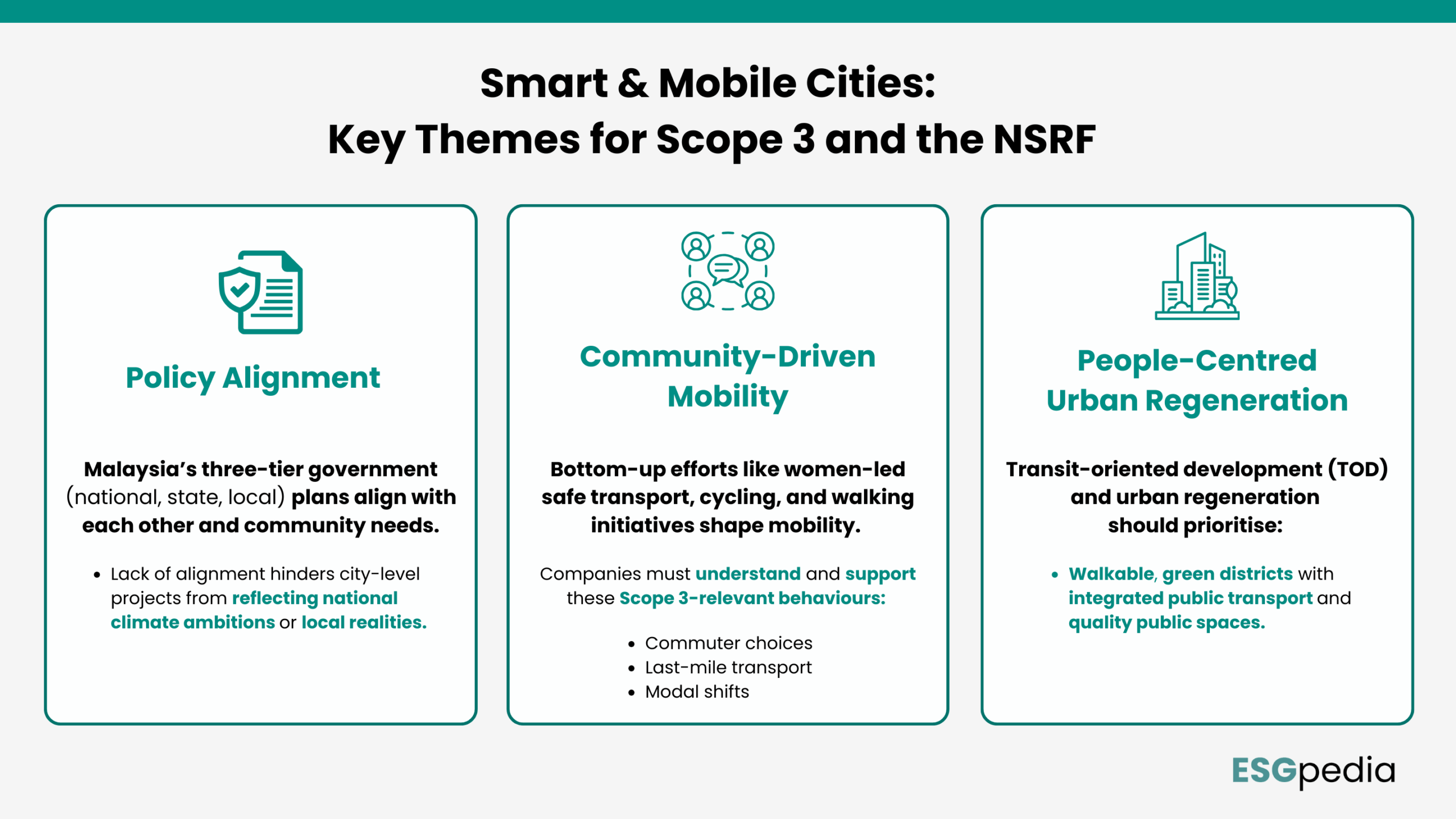
From a corporate perspective, these same issues appear in Scope 3 categories such as employee commuting, upstream and downstream logistics, and use of sold products in cities. As Norliza emphasised, connectivity should be a shared responsibility, not only a government task – a point that resonates strongly for businesses planning decarbonisation strategies in Malaysian cities.
Y.B. Tuan Rajiv Rishyakaran, State Assemblyman for Bukit Gasing, highlighted the hard realities of making public transport a viable alternative to private cars in Klang Valley. He contrasted London’s roughly 8,500 buses with about 1,200 in the Klang Valley today, despite similar population sizes, and pointed to tight public finances and constitutional limits on state and local authority over public transport operations. These systemic constraints affect how quickly Scope 3 emissions from commuting and urban transport can fall, and underline why clear long-term planning and data-driven investment are essential.
From the operator side, Ashok Panchalingam, Head of Business at Prasarana Integrated Development Sdn Bhd (PRIDE), Prasarana Malaysia, described transit-oriented developments that integrate residential, retail, commercial and community spaces with direct access to mass transit. These TODs are starting to transform stations into lifestyle hubs, but face complex coordination, long-term investment needs and the challenge of ensuring accessibility and active mobility (pedestrian and cycling links) around stations. All of these factors will influence emissions from building operations, transport and land-use linking back to Scope 3 categories for developers, landlords and tenants.
The reality on the ground: Scope 3 readiness and common pain points
The Cities Possibilities workshop and Eco-Business research paint a consistent picture of where Malaysian and regional companies stand on Scope 3.
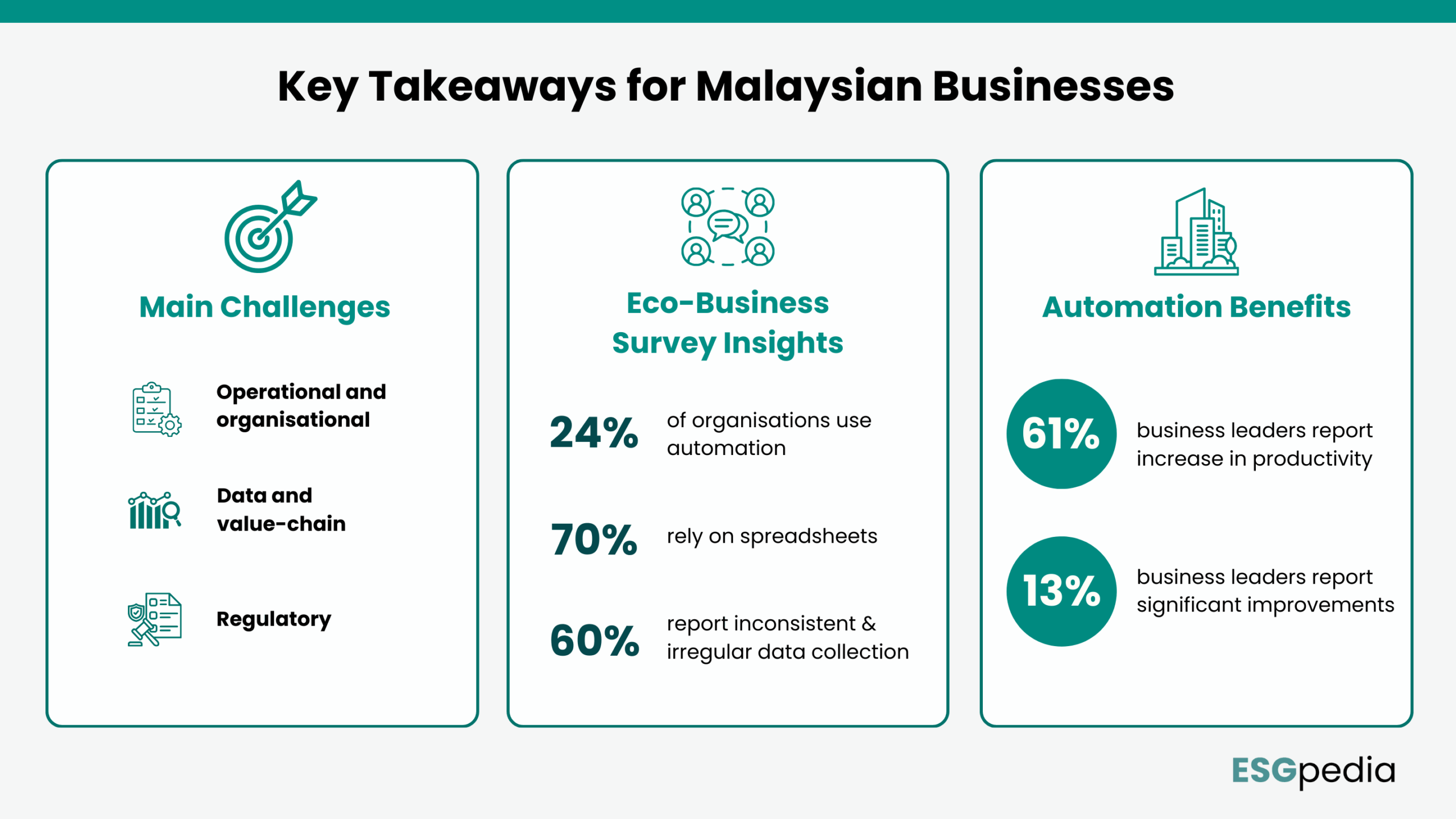
The event summarised three main layers of challenge:
- Operational and organisational: fragmented data, teams working in silos, complex data management processes, and evolving standards.
- Data and value-chain: gaps and inconsistencies in data, limited supplier capacity, and a lack of transparency and standardised processes across the supply chain.
- Regulatory: different standards across jurisdictions and the need to align with both local frameworks (NSRF, SEDG) and global rules (ISSB, CBAM, EUDR, CSRD, CSDDD).
Eco-Business’s survey work in neighbouring Singapore offers a useful proxy:
- Only 24% of organisations are currently leveraging automation in ESG data reporting.
- Around 70% still rely primarily on spreadsheets, 60% on manual data entry, and more than half report inconsistent and irregular data collection.
- Where automation has been implemented, 61% of business leaders report a moderate increase in productivity and 13% report significant improvement.
These trends are highly relevant for Malaysian firms now preparing for NSRF. Manual and spreadsheet-based approaches are unlikely to be sustainable once full Scope 3 requirements and multi-framework reporting (NSRF, SEDG, bank taxonomies, customer questionnaires) come into play.
How technology can make Malaysian Scope 3 and sustainable supply chain journeys smarter and simpler
On Day 2, ESGpedia’s Founder and Managing Director Benjamin Soh shared how technology can bridge data gaps and make NSRF, Scope 3 reporting, and supply chain transparency manageable, especially for under-resourced ESG teams.
In his presentation “Navigating NSRF: Harnessing Technology to Unlock Scope 3 Transparency”, Ben emphasised that the key is not to treat ESG as a stand-alone exercise, but to embed data collection and reporting into day-to-day operations. Many companies struggle with:
- Fragmented data scattered across business units and jurisdictions.
- ESG teams of one or two people trying to service multiple reporting requirements.
- Limited engagement with suppliers and contractors who hold crucial Scope 3 data.
By adopting digital ESG solutions, businesses can streamline data capture by facilitating engagement with suppliers, automate GHG calculations across Scope 1, 2, and 3 emissions, leverage AI to handle large datasets, and generate standards-compliant Sustainability Reports.
These result in real-time savings helping businesses save on manual processes that typically require hundreds of man-hours, and allowing ESG teams to focus on strategy and decarbonisation.
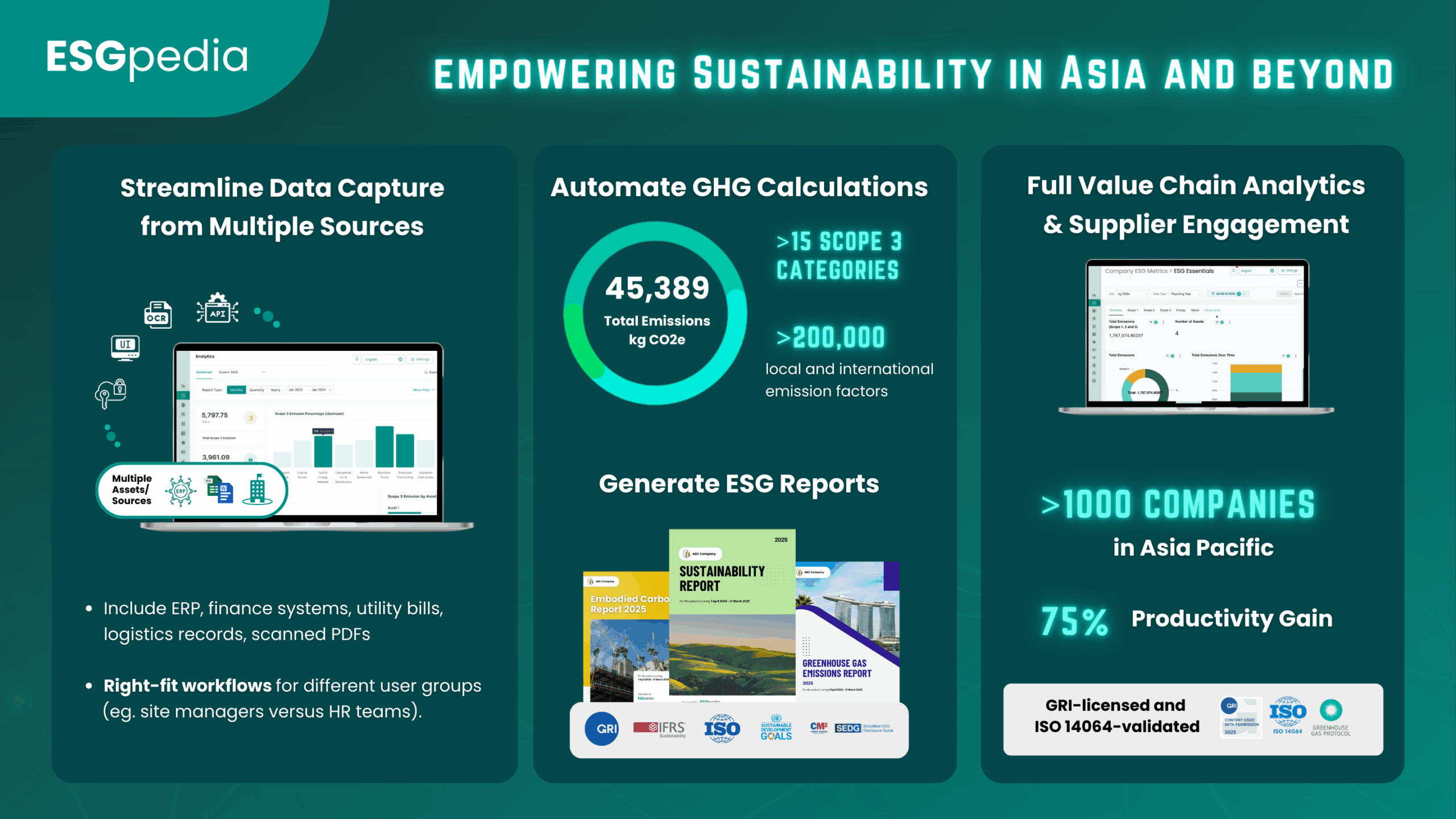
Click here to learn how ESGpedia can help you kickstart sustainability and comply with Malaysia’s NSRF and Scope 3 requirements, including:
- Streamlining data capture from multiple sources (ERP, finance systems, utility bills, logistics records, scanned PDFs) into a single platform, with right-fit workflows for different user groups (for example, site managers versus HR teams).
- Facilitating Supplier Engagement and Supply Chain ESG, helping organisations streamline and actively engage their suppliers, from data collection, to monitoring, analysing, and taking action, to get end-to-end visibility of ESG data to better manage supply chain emissions and support Scope 3 reporting.
- Automating GHG calculations, including all 15 Scope 3 categories, using validated methodologies aligned with the GHG Protocol and ISO 14064, and powered by more than 80 local and international emission factor databases.
- Leveraging AI to handle very large datasets, such as tens of thousands of procurement line items, by matching each item to the most appropriate emission factor. This is a process that would otherwise require hundreds of man-hours.
- Generating standard-aligned sustainability reports (for example, ISSB/IFRS, GRI, local guidance such as SEDG) efficiently, freeing ESG teams to focus on strategy and decarbonisation rather than manual collation.
Ben also shared regional examples, including construction and retail clients, where companies have been able to complete first-time sustainability reports in weeks rather than months, with up to 75% productivity improvements in ESG data management.
For Malaysia specifically, ESGpedia is an ESG Reporting Platform partner of the SEDG Adopter Programme, providing a digital pathway for SMEs in supply chains to measure their emissions and disclose ESG data in a way that aligns with both local and global requirements. This is particularly important where larger listed companies will depend on data from SME suppliers to meet their NSRF and Scope 3 obligations.
As Ben put it during the session, one of the most powerful things companies can do is to “treat Scope 3 reporting as business intelligence, not just compliance, to show where your value chain is carbon- and cost-intensive, and where smarter decisions can unlock both emissions reduction and efficiency gains.”
Simplifying Sustainability Reporting: Three practical starting points for Malaysian companies
Based on the discussions across both days of the Eco-Business event and ESGpedia’s work in the region, three priority actions emerged for Malaysian businesses preparing for NSRF and Scope 3 reporting:
- Map your regulatory and value-chain exposure: Understand which NSRF group you fall into, when your reporting obligations begin, and which global rules (CBAM, EUDR, CSRD, CSDDD) are relevant to your markets and products. Overlay this with a high-level view of your value chain to identify the Scope 3 categories most material to your business. For many, this will include purchased goods and services, upstream logistics, use of sold products and end-of-life treatment.
- Build a data foundation before perfection: Perfection is not the starting point. Begin by consolidating existing operational data (energy, fuel, waste, procurement, transport) into a central system, even if some elements remain estimates at first. Digital tools can help you convert this operational data into emissions figures and streamline subsequent reporting cycles. Over time, you can deepen granularity and expand coverage to more suppliers, sites and business units.
- Engage suppliers and partners early – especially SMEs: Scope 3 progress will depend heavily on SMEs that sit within your supply chain. Frameworks such as SEDG, combined with digital assessment tools like ESGpedia, can lower the barrier for SMEs by providing guided questionnaires, embedded emission factors and report outputs they can reuse across multiple customers and banks. This is also where financial institutions’ sustainable finance programmes can play a role. Many banks are already working with ESGpedia to link better ESG data and decarbonisation plans to preferential financing through sustainability-linked loans.
Start complying with mandatory Scope 3 emissions and international sustainability reporting standards today. Learn more and schedule a call.
Act Now to Prepare your Supply Chain for 2026 and beyond
Malaysia’s NSRF and wider policy landscape signal a decisive shift towards consistent, comparable and reliable sustainability disclosure. And with it, a stronger focus on Scope 3 emissions and supply chain transparency. For companies, this is both a compliance imperative and a strategic opportunity to strengthen competitiveness, especially in export-oriented and carbon-intensive sectors.
The Eco-Business Cities Possibilities event showed that when policymakers, city leaders, businesses and technology providers come together, the conversation quickly moves from “Is this required?” to “How do we do this well?”
For ESGpedia, partnering with Eco-Business on the “Navigating NSRF” workshop as Knowledge Partner was an opportunity to contribute practical examples of how technology can simplify complex reporting, empower SMEs and unlock credible Scope 3 transparency. As NSRF implementation gathers pace, we will continue working with Malaysian corporates, SMEs and financial institutions to turn data into action, supporting a low-carbon, resilient and inclusive future for Malaysia’s cities and supply chains.