





Published 30 October 2025 –
With the United Nation’s (UN) 2030 Agenda for Sustainable Development deadline right round the corner, the 17th UN Global Compact Network Singapore (GCNS) Summit was aimed at driving immediate corporate sustainability action on the UN Sustainable Development Goals (SDGs).
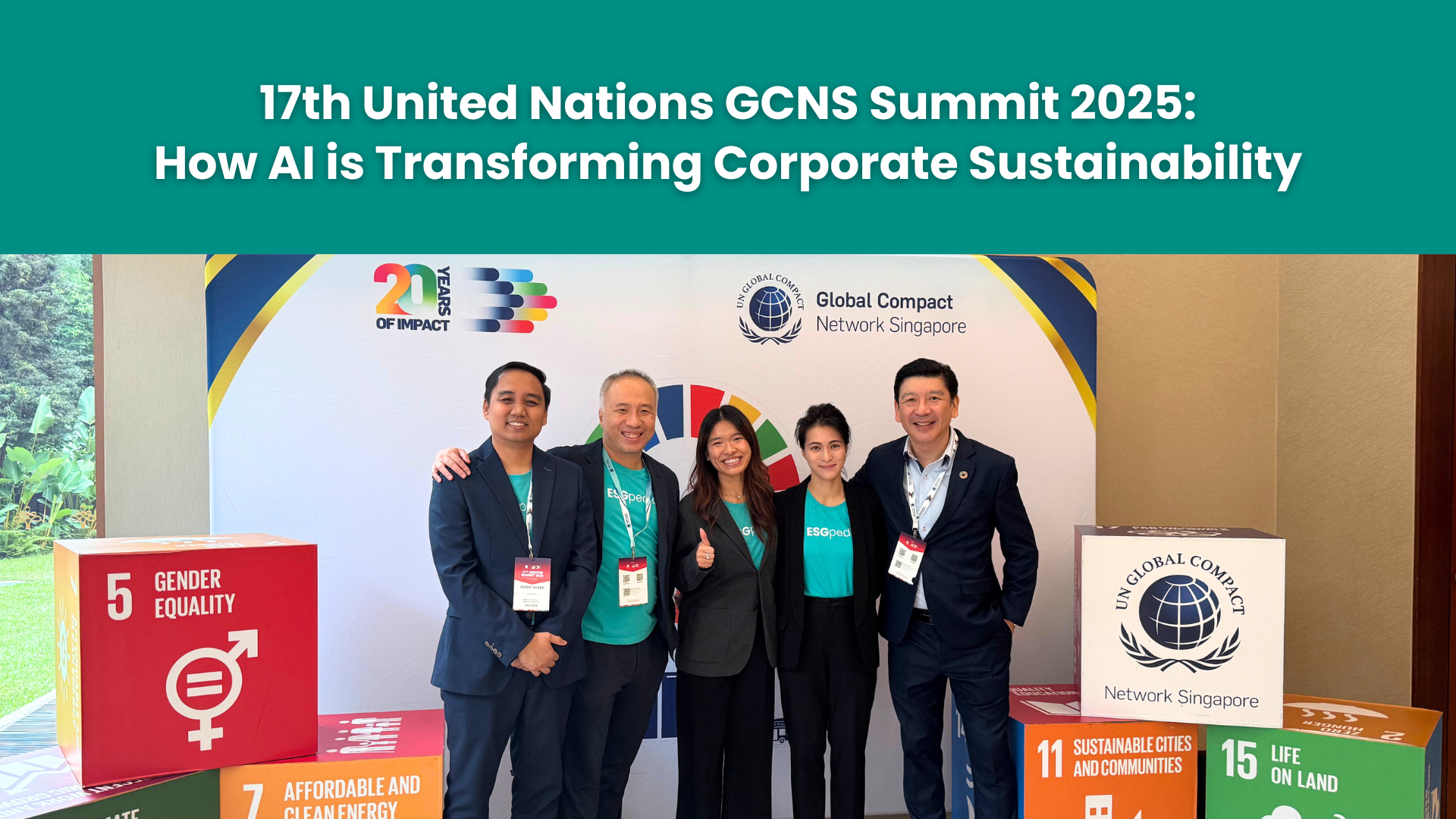
ESGpedia had the honour of speaking at this year’s Summit, themed “Forward Faster: Collective Action and Leadership for a Sustainable Future”, which saw over 450 leaders from business, government, and academia gather to advance collective action for a sustainable future.
From Guest of Honour Indranee Rajah’s keynote calling for credible standards in sustainable finance to discussions on clean energy, the “S” in ESG, carbon markets, and AI, the Summit highlighted the power of partnerships to drive purposeful progress.
AI 360°: How Artificial Intelligence is Shaping Corporate Sustainability – Today and Into the Future
As the world races to meet climate targets, a new KPMG report reveals that a growing number of Chief Executive Officers (CEOs) are confident in their companies’ ability to achieve net zero goals – with AI playing a key supporting role.
The closing plenary explored a timely theme – how AI and digital tools are transforming corporate sustainability agendas.
AI and ESG: Converging for Smarter, Scalable Sustainability

To set the stage for the discussion, Benjamin Soh, Founder and Managing Director at ESGpedia opened the panel with a live agentic demonstration using ESGsmart, an AI chatbot to provide real-time sustainability support. The tool helps users progress on their ESG journey through data-driven insights, automated analysis, and personalised recommendations.
As AI and ESG increasingly converge, automation is reshaping how companies approach sustainability. Beyond simplifying complex reporting and greenhouse gas (GHG) calculations, AI tools empower both large enterprises and SMEs to enhance their sustainability performance through real-time insights and predictive analytics.
A strong example comes from Resorts World Sentosa (RWS), which has integrated AI into its business operations as part of its decarbonisation journey.
Leveraging technology-driven property management, RWS optimises energy consumption across its premises while maintaining guest comfort. Through real-time monitoring and predictive maintenance, the resort identifies opportunities for continuous improvement in efficiency and performance.
“As a large Singapore-based company, RWS publishes annual sustainability reports, which requires data collection from numerous sources across our operations. We’ve begun automating parts of this process using AI and technology – reducing human error and enhancing data confidence,” said Brian Ho, Vice President, Head of Sustainability at Resorts World Sentosa.
Google illustrates another advanced AI use case for “Greening IT”. To keep their Power Usage Effectiveness (PUE) low, Google implements AI to optimise their data centre operations, tapping on renewable sources to further supplement its energy consumption needs.
On the other hand, Google Maps plays a crucial role in “IT for green” — leveraging AI and data insights to recommend traffic light placements and flows for governments, city planners, and users, which save fuel and emissions.
With AI-driven solutions enhancing accuracy, consistency, and credibility of large-scale data management, organisations achieve more than compliance. They can unlock cost savings, improve operational efficiency, and accelerate progress towards sustainability and decarbonisation goals.
Agentic AI will Reshape Sustainability Choices
As AI continues to find its footing in business operations, agentic AI has emerged as a potential gamechanger for the sustainability imperative.

In the future, AI agents could begin to make procurement decisions based on sustainability criteria and performance, reinforcing the importance of clearly showcasing businesses’ sustainability credentials and progress.
Glen Francis, Strategic Advisor at Google Cloud explained, “If your company or product isn’t recognised as sustainable, it may not even be recommended. This is where sustainability intersects directly with AI-driven commerce.”
Empowering the Workforce to Evolve with AI

AI has often been viewed as a threat to jobs, with fears that automation could replace human roles. Yet the panel offered a nuanced perspective: When applied effectively, AI enhances productivity and value creation – complementing, not replacing, human work.
Evolving AI technologies are reshaping the workforce, creating new demand for engineers, data scientists, and operations teams behind AI models as well as electrical engineers to design advanced, high-efficiency systems such as high-voltage and liquid-cooling infrastructure.
“Roles are evolving, and what differentiates talent is skill depth,” emphasised Kenny Sng, Chief Technology Officer at SuperX AI.
At Google, AI is seen as a catalyst for innovation and collaboration. Facility managers now use AI to easily identify energy efficiency opportunities, freeing them from routine tasks to focus on more creative and strategic work.
Similarly, ESGpedia has leveraged AI to help businesses – listed companies, large corporates, and SMEs – achieve significant productivity gains.
“By adopting ESGpedia’s digital sustainability reporting and carbon accounting solutions, corporations have seen up to a 75% increase in productivity – and SMEs close to 100%, as many began sustainability reporting for the first time,” Benjamin explained.
With AI and automation streamlining manual processes, teams can now focus on core operations while ensuring accuracy, compliance, and gain data-driven insights – accelerating their sustainability and decarbonisation journeys.
AI is Here to Stay to Drive Corporate Sustainability Success
As climate tipping points are crossed and the world’s coral reefs face near-irreversible decline, the urgency for tangible climate action has never been greater.“To meet climate targets and avoid exceeding our warming limits, we must scale action – and the only way to scale effectively is through technology,” emphasised Benjamin, highlighting the need for organisations to embrace technology and AI as enablers to accelerate ESG progress.

Technology is only as powerful as the values guiding it. Scaling sustainability will require more than innovation – it demands thoughtful design, collaboration, and a shared vision to harness AI responsibly for people, the planet, and meaningful progress.
Reducing up to 90% effort by employing AI for ESG
By adopting AI-enabled ESG reporting platforms, businesses can prove that they are committed to UN SDGs, through generating sustainability reports to credibly showcase their sustainability efforts.
With the inevitable rise of AI, businesses – especially listed companies – must adopt AI early to stay at the forefront and streamline the integration of corporate sustainability as a core driver of business success to maintain a competitive edge.
Learn how listed companies can manage corporate sustainability while taking advantage of the 5-year ISSB delay here.

ESGpedia adopts the UN SDGs through the ESBN Asia Pacific Green Deal Programme and powers the GCNS Digital Carbon and Emissions Recording Tool (CERT) Tool, which is part of the GCNS LowCarbonSG Programme. The platform leverages AI-driven technology through a one-stop digital platform that streamlines Corporate ESG Reporting, Scope 1, 2, and 3 Greenhouse Gas Calculations, and Supplier Engagement – empowering clients to confidently demonstrate their sustainability commitments to stakeholders.
Get in touch to explore a full suite of digital sustainability solutions.