




Published 20 Mar 2026 –
At first glance, Singapore’s and Malaysia’s forthcoming carbon taxes appear to be local affairs, fiscal instruments designed to price emissions within national borders. Yet in an integrated ASEAN economy, the impact of carbon pricing rarely stays contained.
For companies in the Philippines, this evolving landscape is becoming a material consideration. As the Securities and Exchange Commission (SEC) of the Philippines moves to implement mandatory sustainability reporting for listed companies by 2026, carbon taxes in neighbouring markets are emerging as tangible financial drivers for Philippine businesses to measure, manage, and disclose their emissions and broader ESG performance with greater rigour.
The rising carbon tax implementation across Southeast Asia and pressures on ESG compliance will especially be felt by businesses and exporters in the Philippines, given the country’s “proximity to neighbouring countries and its role in global supply chains” as shared by ESGpedia Vice President Jozsef Acabo in an interview on One News Money Talks with Cathy Yang. From 2026, companies operating in Singapore will face a sharply higher carbon tax of S$45 per tonne of CO₂, while Malaysia is moving towards its own carbon pricing framework on a similar timeline.
Regional supply chains are being reshaped by new requirements in procurement, financing, and sustainable supply chain management. It is pulling Philippine firms into a new climate-accounting reality.
1. Meeting the demand: Sustainable supply chain management and rising expectations from Singaporean and Malaysian buyers
Carbon taxes are blunt instruments, but corporate responses to them are anything but. Faced with higher operating costs, Singaporean and Malaysian companies will look upstream to suppliers and service providers for relief.
For Philippine exporters and contractors, this translates into more demanding requests. Buyers will increasingly ask for carbon footprint data across Scope 1, 2, and relevant Scope 3 emissions, alongside ESG disclosures, evidence of emissions-reduction efforts, and recognised certifications such as ISO 14064 or ISO 14067. The rationale is simple: every tonne of embedded carbon in imported goods or outsourced services adds to the buyer’s taxable footprint.
In practice, sustainability and supply chain ESG is no longer a reputational add-on. Sustainability becomes a commercial parameter much like price, quality, or delivery time.
2. The rise of “hidden compliance pressure”
The Philippines does not yet levy a carbon tax. But Philippine companies are being drawn into what might be called the compliance orbit of their neighbours.
Carbon taxes depend on accurate Scope 3 accounting, which in turn requires emissions data from across the value chain. As Singaporean and Malaysian firms expand and formalise their disclosures, Philippine suppliers become indispensable data providers. Those unable to supply credible carbon information risk being deprioritised in procurement processes or subjected to onerous ESG questionnaires and supplier scorecards.
This dynamic is already visible across the electronics, real estate investment trusts, banking and financial services, and logistics sectors. For these industries with complex, cross border value chains, achieving sustainable supply chain management and transparency is now a core component of ESG efforts in the Philippines, especially under increasing regulatory scrutiny of their global networks.
3. Managing carbon intensity and carbon tax exposure
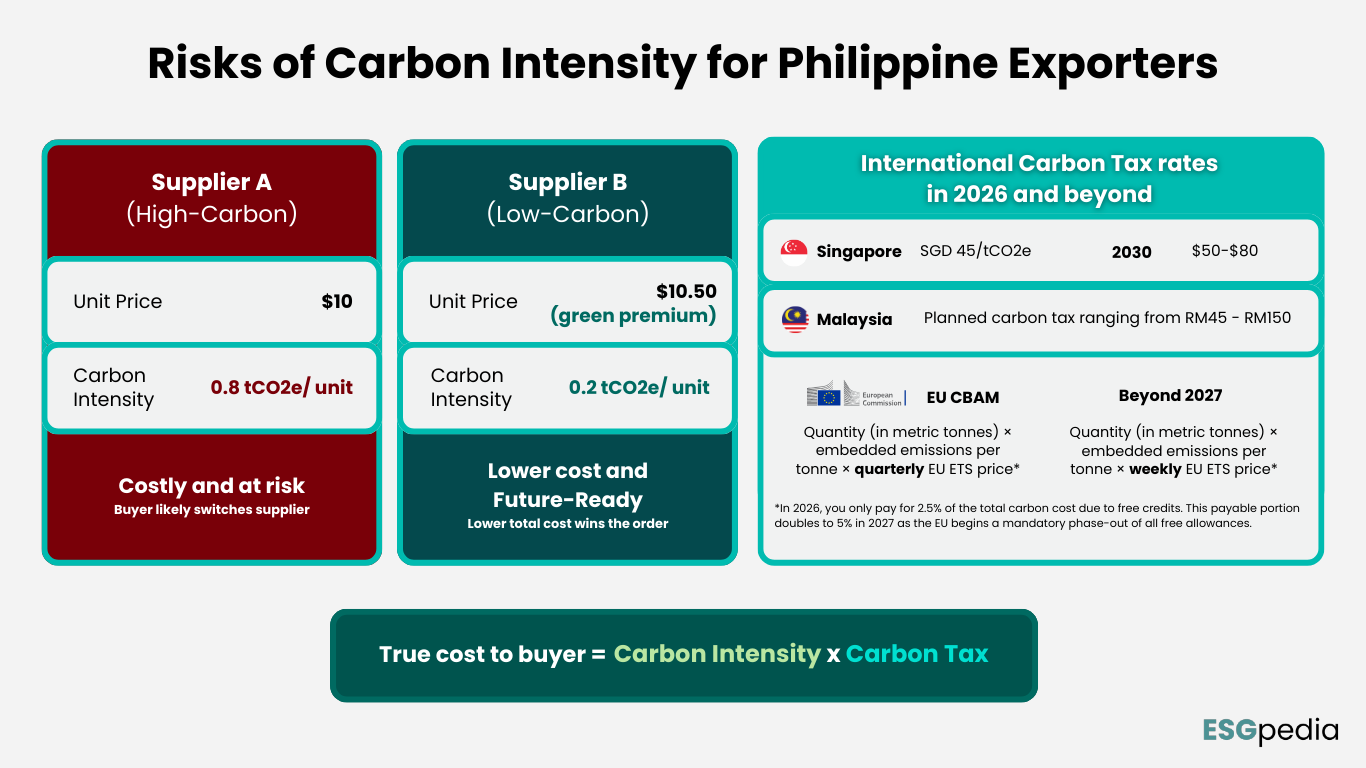
Once carbon is priced, it inevitably becomes a benchmark for competitiveness. Singaporean and Malaysian buyers will compare suppliers not just on unit cost, but on carbon intensity, ESG performance, and the credibility of emissions-reduction programmes.
For Philippine exporters, the implication is stark. A supplier with high emissions or no emissions data at all becomes indirectly more expensive, as it inflates the buyer’s carbon-tax exposure. To remain competitive, firms will need to demonstrate lower energy intensity, cleaner production processes, and credible decarbonisation roadmaps.
In a world of carbon pricing, opacity is a cost.
4. Direct exposure for Philippine groups with regional footprints
The impact is more immediate for Philippine conglomerates with operations in Singapore or Malaysia. Factories, offices, hotels, retail outlets or logistics hubs in these jurisdictions will face direct carbon tax liabilities, raising operational and energy costs while increasing compliance burdens.
Managing this exposure will require facility-level emissions measurement, targeted energy-efficiency projects, internal carbon budgeting, and group-wide sustainability reporting systems. What was once a corporate responsibility function becomes a core financial concern.
5. ESG readiness as a condition for regional financing
Carbon pricing is advancing in tandem with green and sustainability-linked finance. Banks in Singapore and Malaysia are embedding climate metrics into credit assessments, particularly for sustainability-linked loans and climate-aligned lending products.
Philippine companies seeking funding from these institutions will be expected to present ESG disclosures, greenhouse gas baselines, emissions-reduction pathways, and evidence of supplier engagement. Firms that cannot do so may still secure financing, but more slowly, and often at a higher cost, as sustainability-linked loan penalties are triggered.
In effect, carbon readiness is becoming a prerequisite for capital access.
6. An ASEAN-wide shift in Scope 3 expectations
As first movers on carbon taxation in Southeast Asia, Singapore and Malaysia are setting precedents that will shape regional norms. Their policies are already influencing supply-chain practices, reporting standards, and cross-border emissions data requirements across ASEAN.
For Philippine companies, early preparation offers a strategic advantage. Those that invest now in credible carbon accounting and ESG reporting are more likely to become preferred suppliers, trusted financing partners, and resilient participants in a decarbonising regional economy.
Carbon taxes may be levied nationally. Their consequences, however, are unmistakably regional.
The Philippine Exporter’s Roadmap to Decarbonisation: Reducing tax liability through ESG reporting

To remain a preferred partner and competitive in the ASEAN supply chain amidst the rise in climate policies around carbon tax, Philippine firms must prioritise transparency and embark on ESG reporting by harnessing digital solutions.
In 2026, the SEC requires more than just intent; they require measurable, data-backed ESG progress from businesses.
Ready to take the next step? Get in touch with ESGpedia today to learn how we can support your ESG goals and drive tangible business outcomes with Sustainability Reporting, Carbon Accounting, Supply Chain Management, and more.