






Published 7 Apr 2026 –
The Environmental Impact of Manufacturing
Manufacturing companies continue to expand their business operations in Asia-Pacific, drawn by the region’s cost competitiveness, strategic geolocation, and favourable government and trade policies [1].
However, manufacturing and production activities contribute significantly to global greenhouse gas emissions (GHG) and environmental degradation, accounting for one-fifth of global carbon emissions.
By adopting environmentally friendly practices, minimising negative impacts, and conserving energy and resources, the manufacturing industry can reduce their carbon footprint to meet global climate targets.
The cross-border scale and diversity of supply chains in the manufacturing industry call for strategic collaborations across private and public sectors, as well as innovative digital solutions.
Growing Demand for a Sustainable Manufacturing Industry
Starting from 2026, listed companies in many Asia-Pacific countries such as Singapore, Australia, Malaysia, and South Korea will be subjected to mandatory sustainability reporting requirements, including Scope 3 emissions disclosures.
In a recent survey, sustainability has emerged as the top business opportunity for manufacturers to leverage for competitive advantage and capitalise on its potential to attract investors and customers.
Sustainability-conscious consumers who are willing to pay a 9.7% sustainability premium have contributed to this rising demand in sustainable products, with the sustainable manufacturing market expected to hit USD 523.67 billion by 2032.
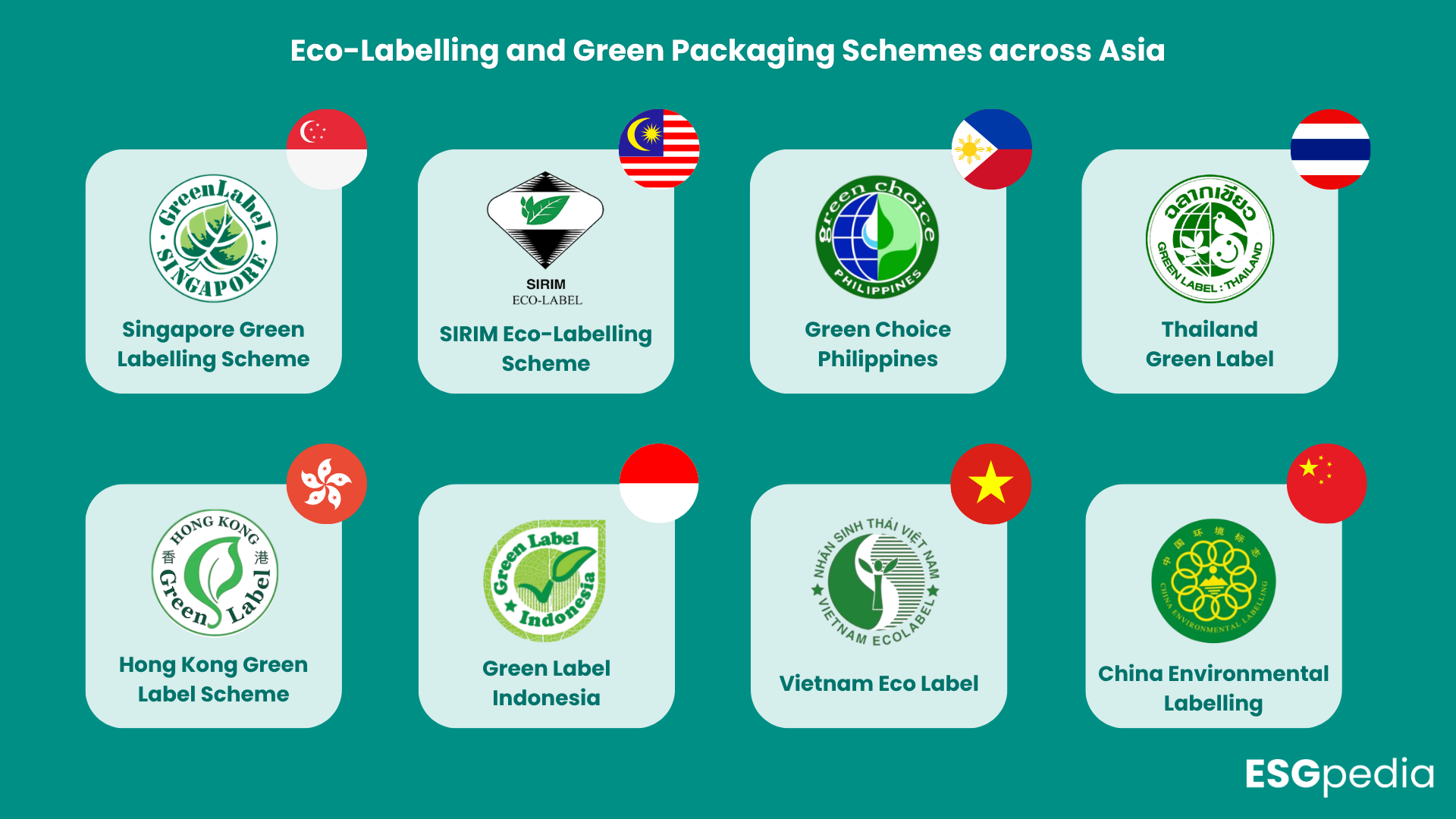
Various Eco-Labelling and Green Packaging Schemes across Asia.
On a national scale, many non-governmental organisations (NGOs), government bodies, and associations have implemented various types of green packaging labels and certifications.
These include the China Green Product (CGP), Japan Environment Association’s Eco Mark Program, the Singapore Green Label Scheme, and the National Ecolabelling Programe – Green Choice Philippines (NELP-GCP), which aim to encourage clean manufacturing practices and the consumption of environmentally friendly products and services.
In Singapore, 34% of manufacturing companies have expressed their intent to commence sustainability reporting within the next 1-3 years, signalling a clear shift towards a greener manufacturing industry and transparency.
In the recent Budget 2026 announcement, green loans under the Enterprise Financing Scheme and the Energy Efficiency Grant have been extended to encourage firms in industrial sectors, including manufacturing, construction, and maritime, invest in energy-efficient and sustainable solutions.
Increasingly, companies that showcase their commitment to sustainability can unlock tangible benefits such as cost savings, greater appeal to investors, and improved marketability to customers.
With 80% of companies seeing sustainability as a profitability driver, manufacturers stand to enjoy long-term savings through sustainability practices such as recycled packaging, green procurement, and data analysis to enhance operational and cost efficiency.
What is Sustainable Manufacturing?
Sustainable manufacturing is the creation of manufactured products through economically-sound processes that minimise negative environmental impacts, while conserving energy and natural resources.
Common sustainable manufacturing practices include:
- Recycling and working towards circular supply chains by increasing the percentage of used materials in the production process
- Turning to renewable energy and energy efficient technologies to reduce carbon footprints, meet environmental standards, and lower costs in the long term
- Green and ethical raw materials/Green Procurement to ensure products are sourced responsibly and sustainably, prioritising suppliers who have adopted sustainable practices
- Design for Sustainable Manufacturing – process of designing products and processes that reduce negative environmental impact while maximising positive social impact throughout their lifecycle
- Carbon management and reduction across Scope 1 to 3 GHG emissions and engaging with suppliers for full value chain decarbonisation
Key Challenges in Decarbonising the Manufacturing Industry
With its wide reach across energy-intensive sectors, manufacturing companies face a realm of unique challenges in their decarbonisation journeys.
Accounting for product-level emissions
Apart from accounting for company-level GHG emissions, a challenge unique to the manufacturing industry is calculating product-level emissions.
- Manufacturers require specific data from the extraction of raw materials, production, transport, to the end-of-life disposal, to gain visibility of the environmental impact of specific products.
- Complex and resource-intensive nature of manufacturing processes make conversion of material usage and energy consumption into carbon emissions challenging
- Lack of expertise, insufficient data, and manpower restraints
Complex Scope 3 emissions calculation and reporting due to extensive supply chains
In 2023, corporates reported that their Scope 3 supply chain emissions were 26 times greater than their Scope 1 and 2 emissions from direct operations.
Notoriously hard to tackle, Scope 3 emissions pose a core challenge to large manufacturers in advancing their carbon reduction efforts:
- Lack of visibility and control over global supply chains and supplier data – suppliers are often SMEs with limited budget and expertise to track their own Scope 1 and 2 emissions
- Lack of internal data and resource-intensive nature of Scope 3 calculations
- Absence of a proper centralised tool to manage copious amounts of data
High initial costs in implementing sustainability practices
Zero- or low-carbon technologies can pose an immediate financial barrier for manufacturers, especially for SMEs with fewer resources.
- Costly upgrades such as renewable energy systems, switching to bio-based materials, and waste recycling facilities to reduce environmental footprint
How to tackle Scope 3 emissions? Innovation and technological advancements for the manufacturing sector
Such challenges in greening the manufacturing industry have not gone unnoticed, with various solutions such as reporting platforms to digitalise and streamline emissions calculations, government grants to support sustainable practices, and many other innovative advancements which the industry can begin exploring to kickstart its sustainability journey.
ESGpedia Use Cases: Enabling a Sustainable Manufacturing Industry
From large manufacturers to SMEs in supply chains, businesses have leveraged ESGpedia’s Sustainability Reporting Module, Supplier Engagement Module, and GHG Emissions Calculator to stay ahead of sustainability regulations and gain competitive advantage.
Razer | Supplier Queen Bee Programme for Full Value Chain Decarbonisation
Razer has adopted ESGpedia for its Supplier Enablement Programme to advance on its green procurement strategy and drive sustainable supply chain, tapping on the SGTech Sustainability Guided Programme (SGTech SGP) for its Singapore-based SME suppliers.
Leveraging ESGpedia’s digital solutions on sustainability reporting, carbon accounting, and dashboard analytics, Razer has effectively streamlined its sustainable supply chain management and achieved a comprehensive overview of its supply chain emissions for enhanced sustainability reporting and value chain decarbonisation, overall bolstering competitiveness and better meeting rising consumer demand for sustainability.
Integrated Precast Solutions | Sustainability Reporting and Environmental Product Declaration (EPD)
Integrated Precast Solutions, a member of the Teambuild Construction Group and a pioneer in Advanced Precast Concrete Technology in Singapore, has leveraged the ESGpedia platform to generate a comprehensive Sustainability Report and published a verified Environmental Product Declaration (EPD).
By conducting a Life Cycle Assessment (LCA) on a harmonised digital platform, Integrated Precast Solutions successfully verified and published its EPD, supporting its pursuit of the Singapore Green Building Product (SGBP) Certification. This milestone reflects the company’s commitment to aligning its products with recognised environmental standards, contributing to a more sustainable manufacturing industry.
The Sustainability Report, EPD, and SGBP Certification not only build trust with investors and customers but also enable data-driven decision-making by providing credible, transparent data on environmental impact. At the same time, they strengthen the company’s competitive positioning, enabling it to meet evolving supply chain requirements and secure stronger preference in sustainability-driven procurement and project tenders.
PSC Corporation | Scope 3 Emissions Calculation for comprehensive Sustainability Reporting
PSC Corporation, a fast-moving consumer goods (FMCG) manufacturer listed on the Singapore Exchange (SGX), has embarked on their Scope 3 emissions calculation and tracking using the ESGpedia platform, achieving a comprehensive overview of their full value chain emissions and advancing on Scope 3 emissions reduction strategies.
Leveraging ESGpedia’s Scope 3 Module, PSC Corporation was able to determine the types of data required to collect and upload the relevant data in a streamlined manner onto the platform, saving much time and effort.
The platform’s dashboard and analytics enabled PSC Corporation to easily identify areas of improvement by categorising the carbon emissions, breaking them down into the 15 sub-categories. With upstream and downstream data from their supply chain, PSC Corporation has gained a comprehensive overview of their Scope 3 emissions.
These practical insights allow companies to easily identify areas of improvement in carbon reduction strategies, uncover cost saving opportunities, and actively collaborate with suppliers to reduce their GHG emissions.
Additionally, customised dashboards and simplified data visualisation allows PSC Corporation to easily extract relevant data for the company’s annual sustainability reporting, enabling them to comply with mandatory reporting requirements for listed companies.
Mitsubishi Heavy Industries (MHI) Group | Sustainability Reporting and Life Cycle Assessments
Mitsubishi Heavy Industries (MHI) Group is one of the world’s leading industrial groups, with business operations spanning energy, logistics & infrastructure, industrial machinery, aerospace, and defence.
With a goal to reduce Scope 1-3 carbon emissions by 50% by 2030 and achieve net zero by 2040, MHI Group has embarked on their sustainability reporting and LCAs on the ESGpedia platform to gain full visibility of their environmental footprint.
By actively tracking their emissions, MHI Group can take practical steps to further their decarbonisation journey, identifying hotspots for emissions reduction and opportunities such as replacing coal-fired thermal power plants with natural gas.
Teo Garments, Kleen Pak, Sunlight Paper, and Cragar Industries | Sustainability Reporting for SMEs
SMEs from the textile, fast-moving consumer goods (FMCG), paper products, and precision manufacturing sectors are onboard ESGpedia, embarking on Scope 1 and 2 GHG emissions calculations and company-level sustainability reporting.
Utilising ESGpedia, the SMEs – Teo Garments, Kleen Pak, Sunlight Paper, and Cragar Industries – were able to easily generate company-level sustainability reports to showcase their ESG credentials and obtain data-driven insights into their emissions.
Having comprehensive sustainability reports to showcase to stakeholders puts SMEs in an advantageous position with increased attractiveness as a preferred brand for consumers, supplier in green procurement tenders for larger corporations, or a potential portfolio company for investors expanding their green investments.
Digital Sustainability Solutions for Manufacturing Companies
Digital tools are integral for manufacturers to bridge ESG data gaps, streamline complex processes, and help businesses transition smoothly towards a green economy.
Digital Data Management – Consolidate and streamline all ESG and carbon data across entire value chains on one platform – easily collecting, aggregating, verifying, and integrating data from multiple locations, assets, business units, and systems to drive business outcomes.
Carbon Calculator – Accurately calculate GHG emissions across Scope 1, 2, and 3, building embodied carbon, and events carbon footprint, using >280,000 APAC-localised emission factors across 1,000+ product categories – validated under ISO 14064 and in accordance with the GHG Protocol.
- Conduct Life Cycle Assessments (LCA) and attain verified Environmental Product Declarations (EPD), according to your needs
Sustainability Reporting – Create comprehensive GHG and ESG reports in accordance with international frameworks such as GRI, TCFD, SASB, and ISSB, and country-specific frameworks, such as SuRe Form, SEDG, and more.
Supply Chain ESG – Advance on your organisation’s sustainability strategy by streamlining and actively engaging suppliers from data collection, monitoring, to analysing and taking action for end-to-end visibility of value chain ESG data through a customised Co-branded Portal.
Sustainable Finance – Financial institutions can more accurately assess sustainability performance, manage risks, and monitor portfolios against ESG taxonomies, while companies can access preferential sustainability-linked finance to advance ESG strategies.
Grants through government funding – Productivity Solutions Grant (PSG)
SMEs are eligible for up to 50% Productivity Solutions Grant (PSG) support in the adoption of ESGpedia, a pre-approved solution under the IMDA SMEs Go-Digital programme.
Get funding support today.
Conclusion
Growing regulations, greener supply chains, and consumer demands are expected to continue driving the demand for a net zero economy and decisive climate action.
Discover a full suite of digital sustainability solutions on ESGpedia to accelerate your green transformation.